The contemporary industrial as well as commercial sectors call for a proper flow of VRC Goods Lifts from one level to another in order to ensure maximum productivity and a safe working environment. Organizations engaged in warehouse operations, factories, logistics firms, retail shops, and manufacturing organizations need lifting equipment that would efficiently move their heavy goods. One of the best methods available for vertical moving of such materials is the use of a vertical reciprocating conveyor.
India Elevator offers a variety of lifting services to cater to the ever-growing requirements of the present industries. This manual is a complete guide on how a vertical reciprocating conveyor works and all you should know about them.
What is a VRC Goods Lift?
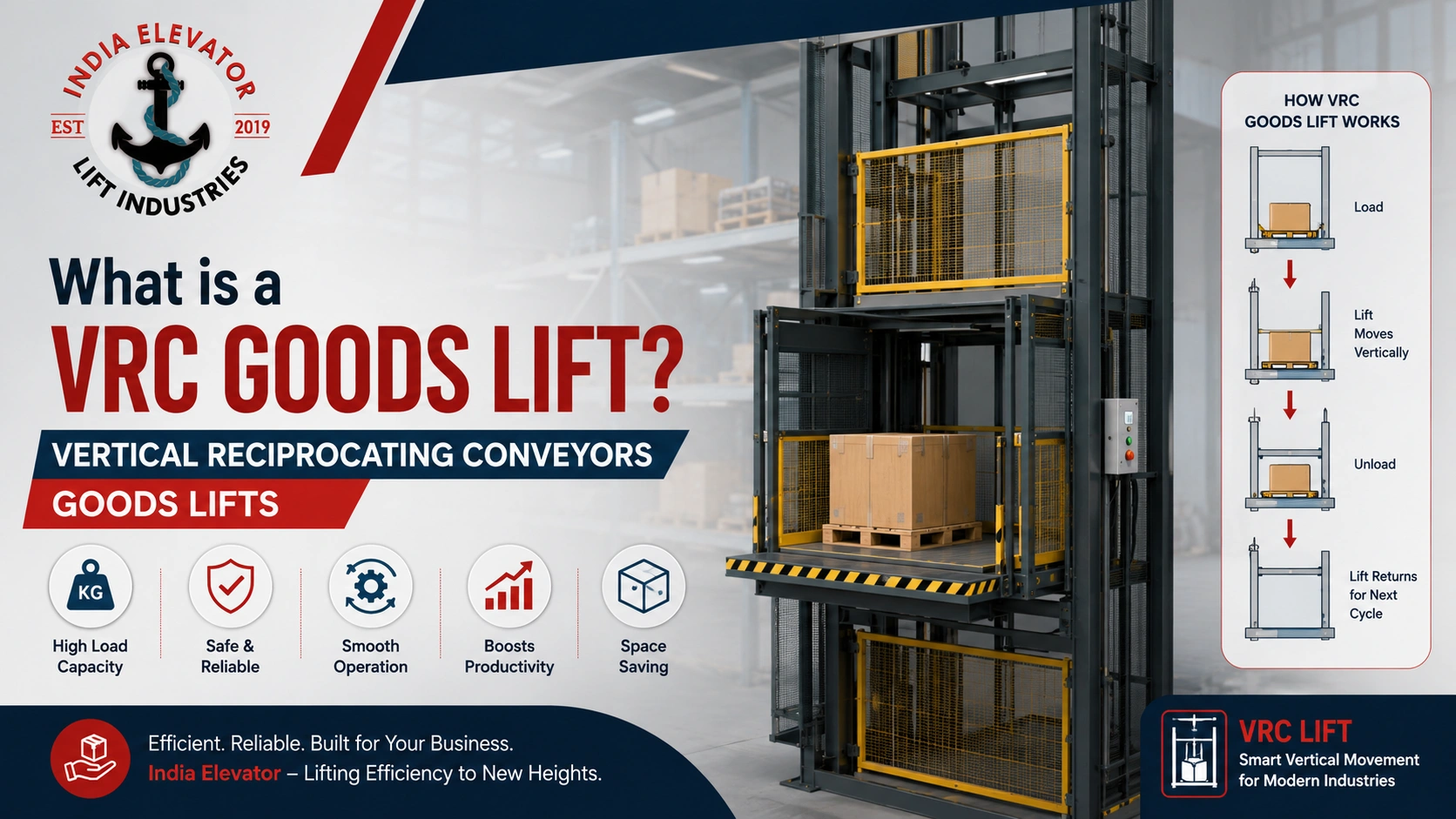
The Vertical Reciprocating Conveyor Lift is a machine lifting device specially made to raise materials, products, equipment, machinery, and cargo vertically within various floors of a building. Contrary to passenger elevators, Vertical Reciprocating Conveyor lifts are meant solely for material transport rather than passenger transport.
The Vertical Reciprocating Conveyor Lift consists of a carriage, platform, guide rail, and lifting system to enable safe and efficient material transport from one floor to another. This kind of vertical transport device is commonly employed in industries where the use of forklifts, ramps, and other means is impractical.
In other words, the VRC elevator is an inexpensive and economical way of moving goods vertically.
Understanding Vertical Reciprocating Conveyors
VRC Goods Lift Reciprocating vertical conveyors are built in such a way as to enable automation of material handling without incurring high labor costs. They are normally fitted in locations where material handling is required on a regular basis between mezzanines, storage areas, production plants, and shipping sections.
VRC Goods Lifts are distinct from freight elevators in that they have been designed to move materials only.
Key Characteristics of Vertical Reciprocating Conveyors
- Designed for goods transportation only
- High load-carrying capacity
- Customizable platform sizes
- Safe and reliable operation
- Reduced material handling time
- Low maintenance requirements
- Efficient use of floor space
Because of these advantages, VRC Goods Lift vertical reciprocating conveyors have become an essential part of modern industrial operations.
How Does a VRC Goods Lift Work?
The working principle of a VRC Goods Lift vertical reciprocating conveyor is straightforward and highly efficient.
Step-by-Step Working Process
- Goods are loaded onto the lift platform.
- Safety gates are secured before operation.
- The lifting mechanism is activated.
- The platform moves vertically along guide rails.
- The system stops automatically at the designated floor.
- Goods are unloaded safely.
- The platform returns for the next cycle.
This automated process minimizes manual labor and ensures smooth movement of materials between levels.
Main Components of a VRC Elevator
A modern VRC elevator consists of several essential components that ensure safe and efficient operation.
1. Lift Platform
The platform carries materials, pallets, cartons, and equipment during transportation.
2. Guide Rails
Guide rails maintain smooth vertical movement and provide stability.
3. Lifting Mechanism
The system may use hydraulic cylinders, chains, cables, or mechanical drives, depending on the application.
4. Safety Gates
Interlocked safety gates prevent unauthorized access during operation.
5. Control Panel
Allows operators to control lift movement and monitor performance.
6. Structural Framework
Provides overall support and stability to the lift system.
7. Safety Sensors
Modern VRC systems include sensors that enhance operational safety and prevent accidents.
Types of VRC Goods Lifts
Different industries have varying material handling requirements. Therefore, several types of vertical reciprocating conveyor systems are available.
Hydraulic VRC Lift
Hydraulic systems use hydraulic cylinders to raise and lower the platform.
Advantages
- Smooth operation
- High load capacity
- Reliable performance
- Suitable for heavy-duty applications
Chain-Driven VRC Lift
Chain-driven lifts use industrial chains and sprockets for vertical movement.
Advantages
- Durable construction
- Suitable for continuous operation
- Lower maintenance requirements
Cable-Operated VRC Elevator
These systems use steel wire ropes and pulleys for lifting.
Advantages
- Cost-effective solution
- Efficient for medium-duty applications
- Compact design
Mechanical VRC Lift
Mechanical systems use gears, motors, and drive assemblies to move materials vertically.
Advantages
- High efficiency
- Long service life
- Precise movement control
Benefits of Installing a Vertical Reciprocating Conveyor
Businesses across industries are increasingly investing in VRC lifts because of their numerous advantages.
Improved Productivity
Materials can be moved quickly between floors, reducing downtime and increasing workflow efficiency.
Enhanced Safety
VRC systems minimize manual lifting and reduce the risk of workplace injuries.
Space Optimization
Unlike ramps, VRC systems require significantly less floor space.
Cost Savings
Automation reduces labor requirements and operational expenses.
High Load Capacity
These systems can handle heavy machinery, pallets, and bulk materials with ease.
Customizable Design
VRC systems can be designed according to building layout and operational requirements.
Long-Term Reliability
Robust construction ensures dependable performance for years.
Applications of VRC Goods Lifts
The versatility of VRC vertical reciprocating conveyor systems makes them suitable for a wide range of industries.
Warehouses
Used for moving pallets and inventory between storage levels.
Manufacturing Facilities
Facilitates the transfer of raw materials and finished products.
Distribution Centers
Improves material flow and order fulfillment processes.
Retail Stores
Supports the movement of goods between stockrooms and sales floors.
Automotive Industry
Used for transporting components and heavy equipment.
Pharmaceutical Industry
Ensures safe handling of sensitive materials.
Food Processing Units
Facilitates the efficient movement of packaged products.
E-Commerce Warehouses
Supports high-volume inventory handling operations.
VRC Lift vs Traditional Freight Elevator
Many businesses wonder whether they should choose a freight elevator or a vertical reciprocating conveyor.
| Feature | VRC Lift | Freight Elevator |
|---|---|---|
| Purpose | Goods Only | Goods & Personnel |
| Installation Cost | Lower | Higher |
| Maintenance Cost | Lower | Higher |
| Space Requirement | Less | More |
| Load Capacity | High | High |
| Operating Efficiency | Excellent | Good |
| Customization | Highly Flexible | Limited |
For facilities focused exclusively on material transportation, a VRC lift is often the more practical and economical choice.
Important Safety Features in VRC Elevators
Safety remains a critical aspect of every lifting system.
Modern VRC elevator systems include:
- Interlocked safety gates
- Emergency stop buttons
- Overload protection
- Limit switches
- Safety sensors
- Mechanical locking devices
- Backup safety systems
These features ensure reliable operation while protecting workers and materials.
How to Choose the Right VRC Vertical Reciprocating Conveyor
Selecting the right system depends on several factors.
Load Capacity
Determine the maximum weight that needs to be transported.
Platform Size
Choose a platform suitable for your material dimensions.
Travel Height
Consider the vertical distance between floors.
Frequency of Use
Higher usage may require heavy-duty configurations.
Installation Space
Evaluate available floor and shaft space.
Safety Requirements
Ensure compliance with applicable safety standards.
Future Expansion
Select a system capable of supporting future operational growth.
Maintenance Tips for VRC Goods Lifts
Regular maintenance helps maximize performance and service life.
Inspect Components Regularly
Check chains, cables, hydraulic systems, and guide rails.
Lubricate Moving Parts
Proper lubrication reduces wear and extends component life.
Test Safety Devices
Ensure all safety features are functioning correctly.
Monitor Load Limits
Avoid overloading the platform.
Schedule Professional Servicing
Periodic inspections help identify issues before they become costly repairs.
Why Choose India Elevator for VRC Goods Lifts?
India Elevator is an industry leader when it comes to developing and producing dependable material handling systems. The VRCs that our company produces are built with safety, efficiency, strength, and reliability in mind.
We offer:
- Customized VRC Goods Lift solutions
- High-quality construction
- Advanced safety features
- Competitive pricing
- Professional installation support
- Excellent after-sales service
Our goal is to help businesses improve productivity through dependable vertical transportation systems.
Conclusion
One of the best ways of handling materials in multiple levels of industries and buildings is by installing vertical reciprocating conveyors. No matter whether you require a VRC Goods Lift, VRC elevator, or any other type of VRC vertical reciprocating conveyor, there is no better way of moving goods between different floors than through these conveyors.
If you are looking for highly functional and durable VRCs, we at India Elevator have got you covered! We are always here to make sure you choose the right conveyor for your business.