Introduction of Vertical Reciprocating Conveyor (VRC)
As the current world is full of rapid industrialization, every second counts. Any delay in the transfer of materials from one floor to another may affect the output process, raise labor costs, cause risk for the employees, and ultimately affect productivity. Here comes into play a very innovative material handling system which is known as VRC Lift. At India Elevator, it is our belief that each and every business needs proper consultation before making any investment, as the correct decision would not only be regarding the machine but also the problem-solving for many years to come.
Be it a warehouse, manufacturing industry, logistics center, pharmaceutical industry, automobile factory, or even a commercial building; learning about the working principle of Vertical Reciprocating Conveyor (VRC) can definitely help businesses to streamline their operations and ensure the safety of the workforce as well. This article has been written in order to provide reliable information on safety, efficiency, and value to businessmen, engineers, warehouse managers, and facility operators without making false promises of selling any product. Our motive at India Elevator is to help customers make the correct decisions.
Why Modern Industries Need Better Vertical Material Handling
With the expansion of industries, there has been a significant increase in production speed. Nevertheless, a lot of companies face a common issue related to transferring heavy loads on different levels of production.
Dependence on human labor or using a forklift for each transfer leads to a high risk of work accidents, damaged goods, additional expenses for labor, and slow-down of production processes. On their own, these issues may not be significant enough, but altogether, they influence profitability, effectiveness, and even safety of workers.
The modern industry needs a system that would be reliable, economical, and created specifically for moving goods. And that is where a Vertical Reciprocating Conveyor is used in industry.
Instead of spending efforts on adding workforce, it is much more reasonable to increase productivity using more effective material handling systems.
What is a VRC?
“WHAT IS A VRC?” has been one of the most commonly asked questions in the field of industrial material handling.
A vertical reciprocating conveyor (VRC) is a robust lifting mechanism that is used specifically for moving cargo, pallets, machinery, cartons, industrial equipment, and raw materials from one floor level to another floor level. Unlike passenger elevators, VRC is fabricated only for moving cargo and can accommodate heavy loads all day long.
VRC is a great choice for industries in which there is a need for continuous material movement without hampering their regular business activities since VRC is a dedicated material lifting device and can accommodate loads very efficiently.
Today, VRC systems are widely installed in:
- Manufacturing plants
- Warehouses
- Distribution centers
- Automobile industries
- Pharmaceutical companies
- Food processing units
- Textile industries
- Cold storage facilities
- Commercial buildings
- Printing industries
Its primary purpose is simple: move materials safely, efficiently, and economically.
VRC Full Form
VRC full form is Vertical Reciprocating Conveyor.
Even though most people tend to incorrectly use the term freight elevator when talking about a VRC, one should know that there are some crucial differences. The design of passenger elevators is meant for carrying people and should follow the code for passenger elevators. However, a Vertical Reciprocating Conveyor is designed for carrying loads only.
Since the use of Vertical Reciprocating Conveyor is for carrying materials only, they can offer greater load capacity, simpler design, and less operational expenses than passenger elevators utilized for industrial needs.
Knowledge of the VRC full form will be helpful for businesspeople in selecting the appropriate equipment rather than choosing the wrong lifting device for industrial uses.
Understanding the Working Principle of a Vertical Reciprocating Conveyor
Contrary to expectations, the functioning of a Vertical Reciprocating Conveyor is quite systematic despite carrying several tons of material.
At the beginning of the process, an operator pushes the control button at the required floor. In consequence, the drive system, which can be hydraulic or mechanical, operates and lifts the platform.
The platform moves upwards following the guide rail, keeping perfect balance throughout the whole process. At the same time, safety locking mechanisms, limit switches, and sensors control the process of lifting.
When the platform reaches the chosen floor, it automatically stops and enables the operator to load or unload the materials. The platform returns to another floor after the procedure in the same way.
Thus, the whole process is automatic; hence, the companies obtain faster movement of their material without mistakes.
What is a VRC Elevator?
VRC Elevator stands for a Vertical Reciprocating Conveyor that is designed to lift materials vertically within industrial and commercial establishments.
In contrast with the regular elevators, the VRC elevator cannot accommodate passengers in its operations. It is specifically designed to be used for the safe movement of heavy loads from one floor to another.
The main advantage of VRC elevators is their capability to operate efficiently despite occupying a small area. The robust construction of VRC elevators enables them to function without any compromise on safety within industrial settings.
Automobile workshops, warehouses, logistics centers, factories, and distribution centers usually have VRC elevators installed.
Vertical Reciprocating Conveyor in Industrial Material Handling
A Vertical Reciprocating Conveyor has emerged as one of the most vital machines in contemporary industrial material handling.
Rather than manually carrying their cargo upstairs or relying solely on forklifts, industries are now using VRCs to develop a more efficient and safe work environment.
VRCs are capable of moving heavy pallets, machinery, industrial tools, boxes, packaged goods, manufacturing materials, spare parts, and stock in warehouses without requiring too much physical effort from employees.
Not only does this enhance efficiency in the processes but also reduces worker strain, workplace injuries, and product damage as well.
For industries that deal with costly or fragile materials, vertical movement is always beneficial for their transportation safety.
Key Benefits of Vertical Reciprocating Conveyors
Businesses invest in Vertical Reciprocating Conveyors because they solve multiple operational problems at the same time.
Some of the most significant benefits include:
- Faster movement of heavy goods.
- Improved workplace safety.
- Lower manual labor requirements.
- Better warehouse organization.
- Reduced product damage during transportation.
- Increased production efficiency.
- High load carrying capacity.
- Smooth and stable lifting.
- Better utilization of vertical space.
- Lower long-term operating costs.
Rather than simply replacing manual transportation, VRC systems improve the overall workflow of an organization.
Where are Vertical Reciprocating Conveyors Used?
Because every industry handles materials differently, VRC systems are designed for diverse applications.
They are commonly used in:
- Warehouses
- Manufacturing industries
- Automobile plants
- Pharmaceutical facilities
- Food processing industries
- Textile factories
- Packaging industries
- Engineering workshops
- Logistics hubs
- Commercial buildings
- Cold storage warehouses
- Printing industries
- Distribution centers
Whether transporting pallets, heavy machinery, cartons, or finished products, VRC systems simplify vertical material movement while improving operational efficiency.
Technical Specification Table
| Specification | Standard Details |
|---|---|
| Equipment Name | Vertical Reciprocating Conveyor (VRC) |
| Application | Vertical Material Handling |
| Load Capacity | 500 kg – 10,000 kg (Customizable) |
| Travel Height | Up to 30 meters |
| Number of Stops | 2–10 Floors |
| Drive System | Hydraulic / Mechanical |
| Platform Size | Customized |
| Platform Material | Mild Steel / Chequered Plate / Stainless Steel |
| Guide Structure | Heavy Duty Steel Guide Rails |
| Control System | Push Button / PLC Based |
| Power Supply | 415V, 3 Phase |
| Lifting Speed | 0.10–0.30 m/s |
| Safety Features | Overload Protection, Emergency Stop, Limit Switches, Safety Locks |
| Installation | Indoor & Outdoor |
| Industries Served | Warehouses, Manufacturing, Pharmaceuticals, Logistics, Automobile, Commercial Buildings |
Safety Features That Make a VRC Reliable
Another reason why many industries opt for a Vertical Reciprocating Conveyor is because of safety issues. The lifting of heavy materials between different floors can be quite dangerous if the lifting mechanism does not have sufficient safety measures incorporated in its design.
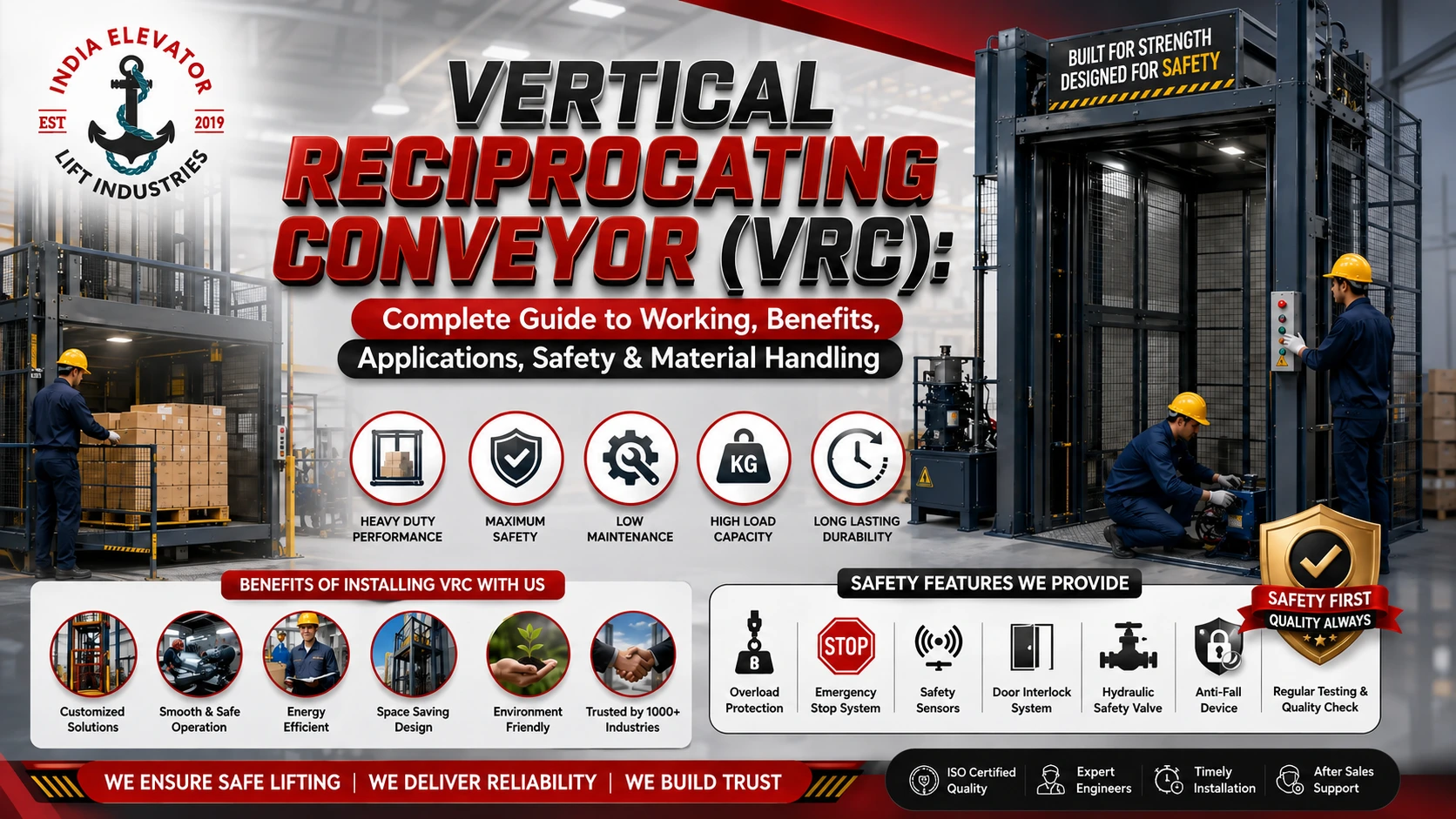
The current VRC is well-equipped with various safety measures, which are meant to enhance the safety of the users and ensure the safety of any materials lifted. Such measures include an emergency stop button, overload protection, a limit switch, a safety lock, a non-slip platform, guide rails, slow lift speeds, and a safe loading platform. The measures are all incorporated to provide safety, eliminate unanticipated movements, and maintain stability in lifting of heavy materials.
However, there is more to ensuring safety than installing the appropriate equipment. Training the operator, inspection of the equipment, and adherence to recommended load capacity are equally vital.
Material Handling Challenges Solved by VRC Systems
All businesses aim for speediness in their processes, but many of them unintentionally waste precious time due to ineffective handling of materials. This is shown through slow handling of materials, broken goods, overworked employees, and bottlenecks in the production process.
The use of a Vertical Reciprocating Conveyor solves this problem by providing a seamless process of vertical transportation of materials. Rather than using forklifts or manual labor, materials are transported vertically without disrupting the production process.
This results in:
- Faster workflow
- Better inventory movement
- Reduced manual handling
- Improved employee safety
- Lower product damage
- Higher operational efficiency
- Better utilization of available floor space
Rather than simply lifting goods, a VRC improves the entire supply chain inside a facility.
Why VRC is Better for Industrial Material Handling
A workplace calls for equipment that will deliver consistent results when subjected to intensive operations. The VRC has been designed precisely for such operations, thus becoming one of the best solutions available for vertical transport.
As opposed to elevators meant for people, a VRC is solely geared towards transporting cargo. With its solid build, varied platform sizes, and high load capacity, a VRC allows businesses to transport loads ranging from pallets, machinery, crates, raw materials to finished products.
No matter whether a workplace deals with a couple of hundred kilograms or several tons per day, selecting the right VRC may be very helpful.
How to Choose the Right VRC Lift
Every facility has different operational requirements, which means there is no universal solution for every business. Selecting the right VRC begins with understanding your actual material handling needs.
Before making a decision, consider the following factors:
- Maximum load capacity required.
- Platform dimensions based on your products.
- Travel height between floors.
- Daily operating frequency.
- Available installation space.
- Hydraulic or mechanical drive preference.
- Indoor or outdoor installation.
- Future expansion plans.
- Required safety features.
- Compliance with local industrial safety standards.
At India Elevator, we always encourage businesses to evaluate their workflow before selecting any lifting system. A solution that perfectly matches your operation will deliver better performance, lower maintenance costs, and greater long-term value.
Common Mistakes Businesses Should Avoid
Many companies purchase lifting equipment based only on price, which often leads to operational challenges later. Selecting a VRC without understanding future production requirements can result in insufficient load capacity, unnecessary maintenance expenses, and reduced efficiency.
Some of the most common mistakes include:
- Choosing a lower load capacity than required.
- Ignoring future business expansion.
- Skipping regular maintenance.
- Overloading the platform.
- Neglecting operator training.
- Purchasing equipment without considering available installation space.
- Ignoring safety certifications and quality standards.
Avoiding these mistakes helps businesses maximize the lifespan and performance of their lifting system.
Maintenance Tips for Long-Term Performance
Even the best and most reliable VRC needs proper maintenance to guarantee safe and efficient work. Besides, preventative maintenance not only helps to prevent unexpected failures but also increases the lifespan of the device.
There are some essential maintenance procedures: hydraulic oil checking (for hydraulic-type VRCs), chain or cylinder inspection, electrical control system testing, guide rail inspection, screws and bolts tightening, platform cleaning, and checking the correct operation of all safety systems.
Businesses need to keep proper service history and conduct periodic technical inspections by qualified specialists. Maintenance is an insignificant cost to pay off expensive repairs in the future.
Why Businesses Trust India Elevator
Understanding that buying industrial equipment involves a large investment, the company is aware that organizations are looking for something more than just a machine when they invest in industrial equipment. The aim is to invest in equipment that will make operations more efficient, safeguard workers, and also help the organization grow.
This explains why at India Elevator, the priority has always been educating the customers first. It has always been the firm’s conviction that every organization should be informed properly about material handling systems, safety norms, maintenance methods, and other such aspects before investing.
In contrast to trying to convince customers to purchase the most costly option, India Elevator informs them about what type of lifting system suits them the most.
The Future of Vertical Material Handling
With automation, smart warehousing, and advanced manufacturing becoming more prevalent in various industries, efficient vertical transport has never been more critical.
Incorporating intelligent control features, enhanced safety technology, energy efficiency, and flexible platforms in current VRCs can help businesses keep up with the demands of their respective industries. Investing in efficient material handling not only ensures future productivity but also promotes a safe work environment while reducing expenses.
Selecting the appropriate material handling equipment is not just about transferring material; it is about creating an efficient system.
Conclusion
Vertical Reciprocating Conveyor (VRC) is not just a lift but a solution that helps in enhancing workplace safety and making the job easier and more efficient by saving manual labor involved in lifting things up and down at industrial and commercial establishments. Knowing what is a VRC, VRC full form, the mechanism of operation of a VRC elevator, and places where a vertical reciprocating conveyor makes the maximum sense will help in decision-making.
No matter whether you have warehouses, factories, logistics companies, pharma industry, food processing units or any other kind of establishment, the selection of VRC depends on understanding the requirements first and not just comparing the prices of various equipment. At India Elevator, we strive to provide information which will help you in selecting your equipment efficiently.
Frequently Asked Questions
1. What is a VRC used for?
A Vertical Reciprocating Conveyor (VRC) is used to transport goods, pallets, machinery, cartons, and industrial materials safely between different floor levels. It is designed exclusively for material handling and is not intended for passenger transportation.
2. What is the VRC Full Form?
The VRC Full Form is Vertical Reciprocating Conveyor. It is a heavy-duty lifting system widely used in warehouses, factories, logistics centers, and commercial facilities for vertical movement of goods.
3. Is a VRC elevator the same as a passenger elevator?
No. A VRC elevator is specifically designed for moving materials, while a passenger elevator is built to transport people. They follow different design principles and safety requirements.
4. Which industries commonly use Vertical Reciprocating Conveyors?
VRC systems are commonly used in manufacturing plants, warehouses, logistics hubs, pharmaceutical companies, automobile industries, food processing units, textile factories, engineering workshops, cold storage facilities, and commercial buildings.
5. What is the maximum load capacity of a VRC?
The load capacity depends on the application and design. Standard VRC systems generally range from 500 kg to 10,000 kg, while customized solutions can be engineered for even higher capacities.
6. Are Vertical Reciprocating Conveyors safe?
Yes. Modern VRCs include multiple safety features such as overload protection, emergency stop systems, limit switches, safety locks, heavy-duty guide rails, and controlled lifting mechanisms. Regular maintenance and proper operation further enhance safety.
7. How often should a VRC be serviced?
Routine preventive maintenance should be performed according to the manufacturer’s recommendations and usage frequency. High-use industrial facilities generally require scheduled inspections every few months to ensure optimal performance.
8. How do I choose the right Vertical Reciprocating Conveyor?
The right VRC depends on factors such as required load capacity, platform size, travel height, installation space, operating frequency, safety requirements, and future business expansion. Evaluating these factors before installation helps ensure long-term efficiency and reliability.