Introduction to EOT Crane
Efficient material handling systems are essential for industries that help enhance productivity and efficiency while ensuring that the work environment is safe from all dangers. The EOT Crane is one such effective lifting system utilized in industries like factories, warehousing, the steel industry, construction, and manufacturing. Whether it is for lifting machinery, transportation of raw materials, or even finished goods, an EOT Crane is a very important tool for improving and enhancing operations in an industry.
A lot of people search online for the EOT crane full form or EOT full form before actually using the equipment. It helps them learn more about EOT cranes and make the best choice of industrial lifting system based on their needs. We design these cranes in such a way that they are easy to use while lifting heavy loads.
At India Elevator, we know how crucial this lifting equipment can be for industries. Along with offering the best material handling solutions, we also focus on educating our customers about industrial lifting systems.
What Is an EOT Crane?
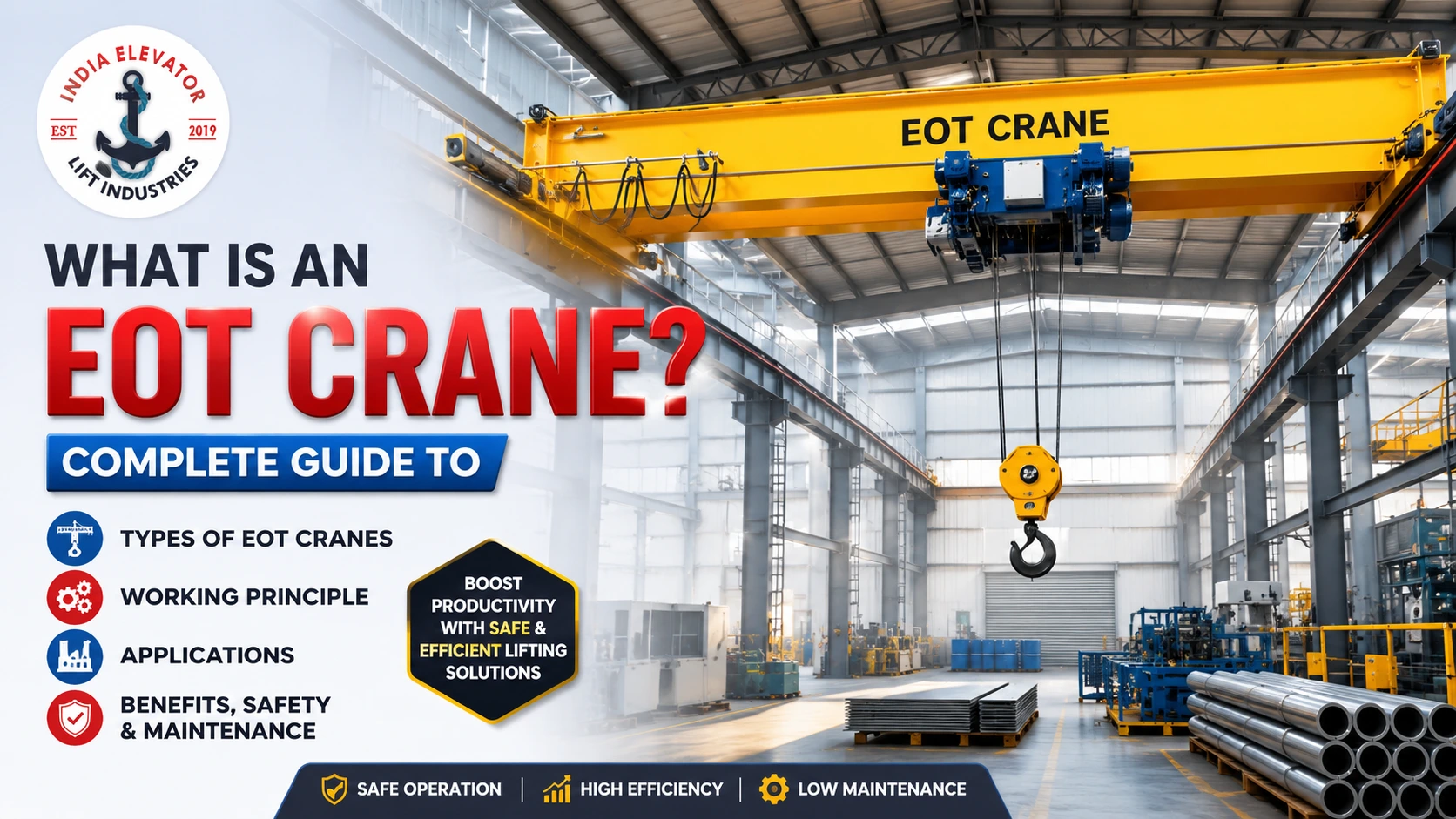
The EOT crane full form is the Electric Overhead Traveling Crane. The EOT Crane name itself gives insight into the nature of the operation of the crane. It can be described as a type of electrically operated crane moving on overhead rails fitted in the building premises of industries. Unlike any other traditional cranes, the EOT crane is capable of horizontal as well as vertical movement.
The EOT full form provides us with the basic knowledge of the EOT crane. “Electric” in the name indicates that the crane is electrically operated, “Overhead” shows that the operation is done at the overhead level, and “Traveling” indicates that it moves along the rails, which cover the whole area of work. The uniqueness of the crane provides more space for industrial activities.
Industrial organizations use EOT cranes because the process helps in reducing manual handling and increasing the speed of production processes, as well as reducing the risk of injuries.
EOT Crane Full Form Explained
The complete form of EOT Crane is Electric Overhead Traveling Crane, and it is one of the most popular types of cranes used for lifting purposes in industries. The knowledge of the EOT full form will help industries understand the importance of such cranes.
Each word in the EOT full form has a specific meaning:
- Electric – Operates using electric motors for lifting and traveling.
- Overhead – Installed above the working area to save floor space.
- Traveling – Moves on rails across the length of the building.
Because of these features, an EOT crane provides greater flexibility than traditional lifting methods. Heavy loads can be transported safely without disrupting workers or production processes. This is why EOT cranes are widely installed in warehouses, automobile plants, engineering industries, fabrication workshops, power plants, and logistics centers.
How Does an EOT Crane Work?
An EOT crane operates through a combination of electric motors, hoists, trolleys, bridges, and control systems. The crane travels on parallel rails fixed to the building structure, while the trolley moves across the bridge beam carrying the lifting hook.
The working process of an EOT crane generally includes the following steps:
1. Load Positioning
The operator positions the hook directly above the material using the crane controls. Modern EOT cranes offer smooth and accurate positioning.
2. Lifting Operation
The electric hoist lifts the load vertically. The lifting mechanism is designed to handle heavy weights safely while maintaining balance.
3. Horizontal Movement
The trolley travels across the bridge while the bridge itself moves along the runway rails. This allows the EOT crane to cover the complete working area.
4. Safe Load Placement
Once the destination is reached, the load is lowered carefully into the desired position, ensuring safety and accuracy.
This efficient working mechanism makes EOT cranes one of the most dependable material handling solutions in modern industries.
Main Components of an EOT Crane
Understanding the major parts of an EOT Crane helps operators and buyers select the right crane according to industrial requirements.
Bridge Girder
The bridge girder is the main horizontal structure that supports the entire crane system. It carries the trolley and hoist while moving across the runway rails.
Hoist
The hoist is responsible for lifting and lowering heavy loads. It uses electric motors, wire ropes, or chains depending on the crane design.
Trolley
The trolley moves along the bridge girder and carries the hoist to different lifting positions. This movement provides excellent flexibility during material handling.
End Carriages
These support the bridge and enable the crane to travel smoothly on the overhead runway system.
Hook Block
The hook securely holds the load during lifting operations. Different hook capacities are available depending on the lifting requirement.
Control System
Modern EOT cranes use pendant controls, cabin controls, or wireless remote systems that allow operators to control movements safely and efficiently.
Motors and Gearboxes
Electric motors power every movement of the crane, while gearboxes ensure smooth and controlled operation.
Types of EOT Cranes
Different industries require different lifting capacities. Therefore, EOT cranes are available in multiple designs.
Single Girder EOT Crane
A single girder EOT crane uses one bridge beam to support the hoist. It is ideal for light and medium-duty industrial applications.
Applications
- Small manufacturing units
- Warehouses
- Assembly plants
- Packaging industries
- Maintenance workshops
Advantages
- Lower installation cost
- Lightweight structure
- Easy maintenance
- Energy efficient
- Suitable for moderate lifting capacity
Double Girder EOT Crane
A double girder EOT crane features two bridge girders that provide greater strength and stability. It is designed for heavy-duty industrial operations where higher lifting capacities are required.
Applications
- Steel plants
- Heavy engineering industries
- Cement factories
- Power plants
- Shipbuilding yards
Advantages
- Higher lifting capacity
- Greater lifting height
- Better stability
- Suitable for continuous operations
- Longer service life
Top Running EOT Crane
In this design, the crane runs on rails mounted above the runway beams. It provides maximum hook height and is suitable for heavy industrial environments.
Industries choose this type of EOT crane when handling extremely heavy machinery or oversized components.
Under-Running EOT Crane
An under-running EOT crane travels beneath the runway beams. It is commonly installed where floor space is limited, and building structures cannot support top-running systems.
These EOT cranes are frequently used in workshops, repair facilities, and smaller manufacturing units.
Why Industries Prefer EOT Cranes
Industrial productivity largely relies on safe and efficient transportation of materials. It is one of the major reasons why EOT cranes have become so important in various industries. As compared to manual methods of lifting, an EOT Crane ensures increased efficiency, speed, safety for workers, and low operating costs.
Another reason for businesses liking EOT cranes is their adaptability to lifting capacity, span, height, and other operational needs of the company. No matter whether you require light lifting operations or need some heavy-duty industrial lifting, there is an EOT crane for any industry.
At India Elevator, we understand that selecting the proper lifting equipment is an investment in your productivity, safety, and future success. Knowing about the EOT crane full form, the EOT full form, and the functioning of EOT cranes makes it easier for companies to choose proper lifting equipment.
Applications, Benefits, Safety & Maintenance of EOT Cranes
Applications of EOT Cranes Across Industries
An EOT crane is one of the most versatile material handling systems used in modern industries. From lifting lightweight components to transporting massive industrial equipment, EOT cranes simplify heavy-duty operations while improving workplace safety and productivity. After understanding the EOT crane full form and EOT full form, it becomes easier to appreciate why these cranes are indispensable across different sectors.
Manufacturing Industries
Manufacturing plants rely heavily on an EOT crane for moving raw materials, machine parts, molds, dies, and finished products. Continuous production requires fast and safe material movement, making EOT cranes an ideal solution for maintaining workflow efficiency.
Steel and Metal Industries
Steel plants handle extremely heavy coils, billets, beams, and fabricated structures. Here, EOT cranes are designed with higher lifting capacities to transport loads safely without interrupting production.
Automobile Industry
Vehicle manufacturing facilities use an EOT crane for lifting engines, chassis, gearboxes, and heavy automotive components during assembly. The precision movement of EOT cranes helps reduce production time while ensuring safe handling.
Warehouses and Logistics
Warehouses use EOT cranes to load, unload, and organize bulky goods efficiently. Their overhead design saves floor space and speeds up inventory movement.
Power Plants
Power generation facilities require an EOT crane for installing turbines, generators, transformers, and other heavy equipment. The reliability of EOT cranes ensures uninterrupted maintenance and operational activities.
Construction Industry
Large construction projects use EOT cranes for lifting steel structures, concrete blocks, machinery, and construction materials. Their ability to handle heavy loads makes them essential equipment for infrastructure development.
Shipbuilding Industry
Shipyards utilize heavy-duty EOT cranes for moving ship sections, engines, and oversized marine equipment with exceptional precision.
Cement and Mining Industries
Mining and cement plants operate in demanding environments where EOT cranes assist in lifting crushers, conveyors, motors, and heavy machinery safely.
Benefits of EOT Crane
Investing in an EOT crane provides long-term operational and financial advantages for businesses. Understanding the EOT crane full form also helps organizations realize why these cranes are considered one of the most efficient industrial lifting systems available today.
1. Increased Productivity
An EOT crane significantly reduces the time required for material handling. Faster movement of heavy loads increases production efficiency and minimizes operational delays.
2. Improved Workplace Safety
Manual lifting often leads to workplace injuries. EOT cranes reduce human involvement in heavy lifting, creating a safer working environment.
3. Better Space Utilization
Since an EOT crane operates overhead, valuable floor space remains available for production activities, storage, and equipment installation.
4. Higher Load Capacity
Modern EOT cranes can lift loads ranging from a few hundred kilograms to hundreds of tons, making them suitable for almost every industrial application.
5. Cost Savings
Although the initial investment may be higher, an EOT crane reduces labor costs, minimizes product damage, and lowers long-term operational expenses.
6. Precise Material Handling
Advanced controls allow operators to position loads accurately, reducing errors during manufacturing and assembly operations.
7. Reduced Downtime
Reliable EOT cranes improve workflow continuity by ensuring materials are transported quickly between different production stages.
8. Customizable Design
Businesses can customize an EOT crane according to lifting capacity, span length, hook height, duty cycle, and operational requirements.
9. Long Service Life
High-quality EOT cranes are manufactured using durable steel structures and premium components, ensuring reliable performance for many years.
10. Low Maintenance Cost
Routine servicing keeps an EOT crane operating efficiently while minimizing unexpected repair expenses.
Essential Safety Guidelines for EOT Crane Operations
Safety should always be the highest priority while operating an EOT crane. Proper training and preventive measures help reduce accidents and equipment damage.
Inspect the Crane Before Use
Operators should inspect wire ropes, hooks, brakes, motors, control systems, and electrical connections before starting work.
Never Overload the Crane
Every EOT crane has a specified Safe Working Load (SWL). Exceeding this limit can damage the crane and create serious safety risks.
Use Certified Operators
Only trained and authorized personnel should operate EOT cranes to ensure safe and efficient handling.
Maintain Clear Communication
Use hand signals, wireless communication, or warning systems whenever lifting heavy loads in busy workplaces.
Keep the Area Clear
Workers should never stand beneath suspended loads while an EOT crane is operating.
Lift Loads Smoothly
Avoid sudden starts, stops, or jerky movements to prevent load swinging and equipment stress.
Regular Maintenance
Routine inspections and preventive servicing ensure EOT cranes remain safe and reliable throughout their operational life.
Wear Personal Protective Equipment
Operators and nearby workers should wear helmets, gloves, safety shoes, reflective jackets, and other required PPE.
EOT Crane Maintenance Tips
Proper maintenance directly affects the performance and lifespan of an EOT crane. Following a structured maintenance schedule helps prevent costly breakdowns.
Daily Inspection
- Check wire ropes for wear.
- Inspect hooks for cracks.
- Test brakes and emergency stop functions.
- Verify smooth trolley movement.
- Ensure electrical controls operate correctly.
Weekly Maintenance
- Lubricate moving components.
- Tighten loose bolts and fasteners.
- Inspect gearboxes.
- Check motor performance.
- Clean electrical panels.
Monthly Maintenance
- Inspect bridge alignment.
- Examine runway rails.
- Check wheel conditions.
- Test overload protection systems.
- Verify control panel functionality.
Annual Maintenance
A complete inspection should include structural analysis, electrical testing, motor servicing, gearbox inspection, load testing, and replacement of worn-out components to ensure the EOT crane continues operating safely.
How to Choose the Right EOT Crane
Selecting the right EOT crane depends on several important factors. Businesses should evaluate operational needs before investing.
Lifting Capacity
Choose an EOT crane capable of handling current and future load requirements safely.
Span Length
The crane span should match the width of the building for maximum coverage.
Lifting Height
Consider the maximum hook height required for lifting operations.
Duty Cycle
Continuous industrial operations require heavy-duty EOT cranes, while occasional lifting may only require standard-duty models.
Working Environment
High-temperature plants, chemical industries, and outdoor environments may require specially designed EOT cranes with corrosion-resistant or heat-resistant features.
Safety Features
Select cranes equipped with overload protection, emergency stop systems, limit switches, anti-collision devices, and advanced braking systems.
Why Choose India Elevator for EOT Cranes?
When investing in industrial lifting equipment, selecting a trusted supplier is just as important as choosing the right crane. India Elevator is committed to delivering reliable, efficient, and high-performance material handling solutions that meet diverse industrial requirements.
Our Advantages
- Premium-quality EOT cranes
- Customized lifting solutions
- Strong engineering expertise
- High safety standards
- Durable construction
- Competitive pricing
- Professional installation support
- Timely maintenance services
- Excellent customer assistance
- Long-term operational reliability
At India Elevator, every EOT crane is designed with a focus on performance, safety, and durability, helping businesses improve productivity while ensuring secure material handling.
Conclusion
The importance of knowledge about the full form of EOT Crane, EOT crane full form, and the complete functioning of EOT cranes is essential in making informed decisions for the purchase of industrial lifting equipment. No matter whether it is used in manufacturing, the steel industry, a warehouse, construction, or logistics, EOT cranes provide maximum efficiency, better safety, and reduced cost of operations in the long run.
All the factors ranging from the selection of the proper type to proper maintenance and safety measures help to enhance the performance and life span of EOT cranes. Routine inspections, properly trained operators, and preventive maintenance help in providing reliable performance with minimum downtime.
If you are in search of reliable, high-performance EOT cranes engineered to perfection, India Elevator provides custom-made lifting solutions to suit the changing needs of industrial organizations.
Frequently Asked Questions (FAQs)
1. What is the EOT crane full form?
The EOT crane full form is Electric Overhead Traveling Crane, an electrically operated overhead lifting system used in industries.
2. What is the EOT full form?
The EOT full form stands for Electric Overhead Traveling, describing the crane’s electric-powered overhead movement.
3. Where are EOT cranes used?
EOT cranes are commonly used in manufacturing plants, warehouses, steel industries, construction sites, automobile factories, power plants, shipyards, and logistics centers.
4. What is the lifting capacity of an EOT crane?
An EOT crane can handle loads ranging from a few hundred kilograms to several hundred tons, depending on its design.
5. What are the main types of EOT cranes?
The primary types include Single Girder, Double Girder, Top Running, and Under Running EOT cranes.
6. Why are EOT cranes important?
They improve productivity, reduce manual labor, enhance safety, optimize floor space, and ensure efficient material handling.
7. How often should an EOT crane be maintained?
Routine daily inspections, scheduled preventive maintenance, and annual comprehensive servicing are recommended.
8. Are EOT cranes safe?
Yes. When operated by trained personnel and maintained properly, EOT cranes are among the safest industrial lifting systems.
9. How do I choose the right EOT crane?
Consider lifting capacity, span, hook height, duty cycle, work environment, and safety features before selecting an EOT crane.
10. Why choose India Elevator for EOT cranes?
India Elevator provides high-quality EOT cranes, customized solutions, expert support, reliable performance, and comprehensive after-sales service for industrial material handling needs.