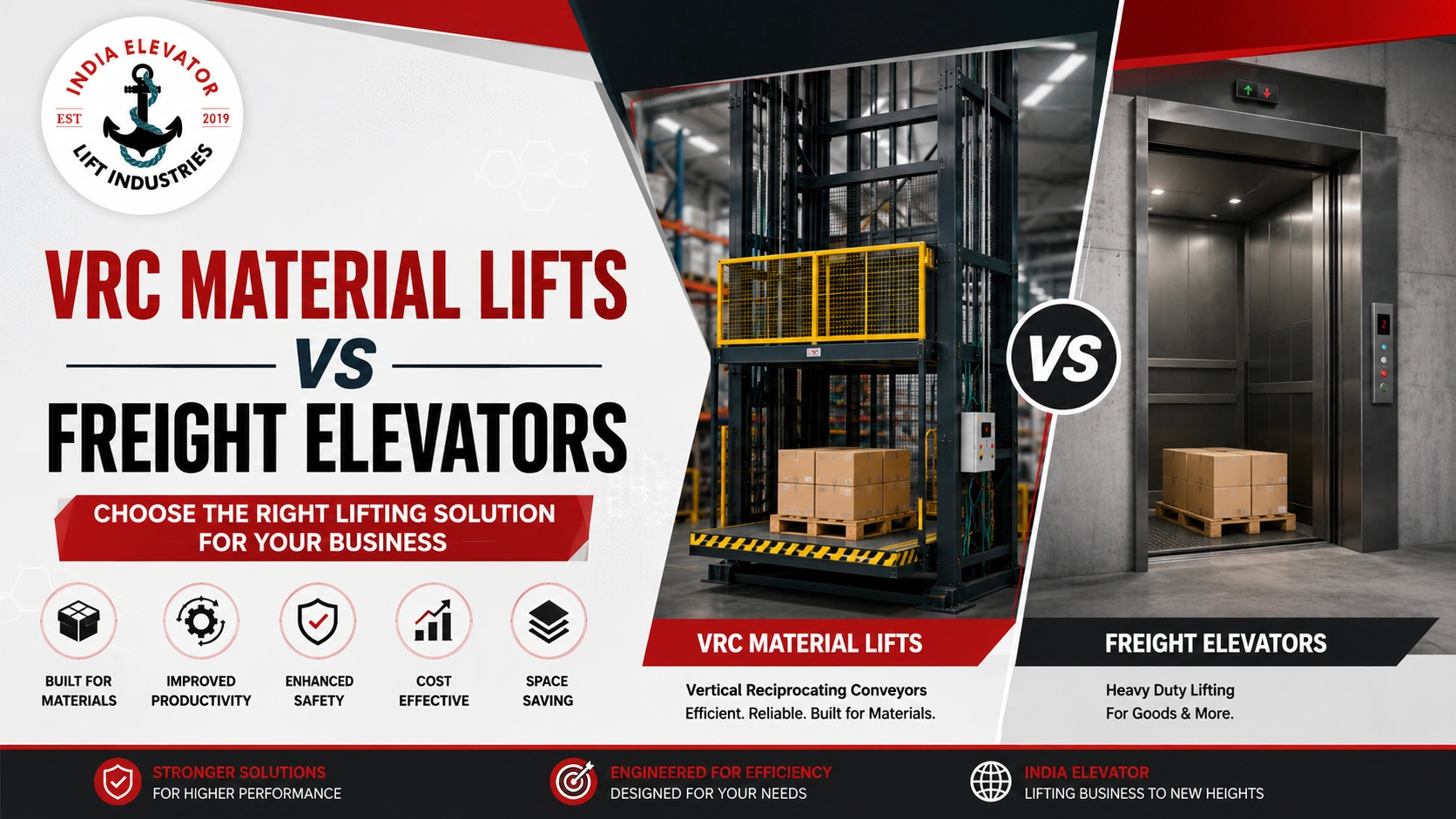
Transportation of cargo from one floor to another requires business owners to make a very important decision when selecting an appropriate lifting system. Most warehouses, factories, manufacturing units, and other similar establishments would benefit greatly by having a more efficient and safer way of moving their materials. The two most popular solutions to this problem include VRC lifts and freight elevators.
While both of these pieces of equipment are used for vertical transportation, they have significant differences in terms of design, affordability, performance, and application. By learning about these differences, business owners will be able to choose the most appropriate solution.
As experts at India Elevator, we understand how important it is to have highly effective lifting devices in your company. Our company provides detailed comparison guides that help business owners to decide which one to choose.
What is a VRC Lift?
VRC Lift (Vertical Reciprocating Conveyor Lift) is a lifting equipment specifically used for transporting materials between the floors of a structure. The device is not meant for people but can be found in both commercial and industrial buildings.
The functioning of a VRC elevator depends on guide rails, lifting devices, safety gates, and a platform through which the materials can be transported to another floor.
The working principle behind VRC lift is a reciprocating conveyor where materials are moved up and down several floors without taking up much space.
What is a Freight Elevator?
Freight elevators are elevators that can carry cargo and some machinery from one floor to another. Freight elevators are usually enclosed in an elevator shaft similar to those of passenger elevators; however, they are different from VRC lifts.
Freight elevators are commonly found in:
- Shopping malls
- Hotels
- Hospitals
- Warehouses
- Commercial buildings
- Distribution centers
These elevators are designed to handle larger loads while providing safe transportation for both goods and authorized personnel.
Understanding Vertical Reciprocating Conveyors
One such solution that is very effective is the vertical reciprocating conveyor. Vertical conveyors have been built especially for the vertical transport of merchandise and equipment.
Vertical conveyor systems deal only with the transportation of goods and not with passengers, which makes them highly effective and economical.
Key Features of Vertical Conveyors
- Dedicated goods transportation
- High load capacity
- Space-saving design
- Reduced labor requirements
- Improved workflow efficiency
- Lower maintenance costs
- Enhanced workplace safety
Because of these benefits, many industries now prefer vertical conveyor systems over conventional freight elevators.
How VRC Lifts Work
A VRC elevator uses a lifting platform that travels along guide rails between designated floors.
Working Process
- Goods are loaded onto the platform.
- Safety gates are secured.
- The lifting mechanism is activated.
- The platform travels vertically.
- The system stops at the target level.
- Materials are unloaded.
- The platform returns for the next operation.
This simple yet highly effective design makes the reciprocating conveyor ideal for continuous material movement.
How Freight Elevators Work
Freight elevators operate using electric traction systems or hydraulic mechanisms.
Working Process
- Goods are loaded into the elevator cabin.
- Elevator doors close automatically.
- The elevator travels within an enclosed shaft.
- The cabin reaches the selected floor.
- Doors open automatically.
- Goods are unloaded.
Freight elevators are designed for both goods transportation and occasional personnel access, depending on local regulations.
VRC Material Lifts vs Freight Elevators: Key Differences
1. Purpose
VRC Lift
Designed exclusively for transporting goods and materials.
Freight Elevator
Designed for transporting goods and, in many cases, authorized personnel.
Winner
For dedicated material handling, the VRC lift is often the better choice.
2. Installation Cost
VRC Elevator
Generally requires lower installation costs because it has a simpler design and fewer structural requirements.
Freight Elevator
Typically involves higher installation expenses due to enclosed shafts, elevator cabins, doors, and advanced control systems.
Winner
VRC Elevator
3. Maintenance Cost
Vertical Reciprocating Conveyor
Fewer moving components mean lower maintenance requirements.
Freight Elevator
Requires regular inspections, servicing, and maintenance of elevator systems.
Winner
Vertical Reciprocating Conveyor
4. Space Requirements
VRC Lift
Occupies minimal floor space and can often be installed in existing facilities with limited modifications.
Freight Elevator
Requires a dedicated shaft and additional construction work.
Winner
VRC Lift
5. Load Capacity
Both systems can handle heavy loads, but vertical conveyors are often customized for specific industrial requirements.
Typical Applications
- Heavy machinery
- Pallets
- Bulk materials
- Industrial equipment
- Production components
Winner
Tie – depends on application requirements.
6. Operational Efficiency
VRC Lift
Designed specifically for repetitive material movement and high-volume operations.
Freight Elevator
Suitable for mixed-use applications involving goods and personnel.
Winner
VRC Lift for industrial material handling.
7. Safety
Both systems include advanced safety features.
VRC Safety Features
- Safety gates
- Emergency stop systems
- Limit switches
- Overload protection
- Mechanical safety locks
Freight Elevator Safety Features
- Automatic doors
- Emergency communication systems
- Backup power options
- Multiple safety sensors
Winner
Both offer excellent safety when properly maintained.
Advantages of VRC Material Lifts
Businesses increasingly choose vertical reciprocating conveyors because of their numerous benefits.
Cost-Effective Solution
VRC systems generally cost less to install and maintain compared to freight elevators.
Faster Material Handling
Efficient transportation helps improve workflow and productivity.
Flexible Design
Platforms can be customized according to load requirements.
Space Optimization
Ideal for facilities with limited floor space.
Improved Safety
Reduces manual lifting and material handling risks.
Long-Term Reliability
Heavy-duty construction ensures dependable performance for years.
Advantages of Freight Elevators
Freight elevators also offer several benefits.
Multi-Purpose Use
Can transport both goods and personnel.
Enclosed Transportation
Protects materials during movement.
Suitable for Commercial Buildings
Often preferred in hotels, hospitals, and retail facilities.
Enhanced Accessibility
Provides convenient access between multiple floors.
Industries That Prefer VRC Lifts
The following industries commonly use VRC vertical reciprocating conveyor systems:
Manufacturing Plants
Moving raw materials and finished products.
Warehouses
Transporting pallets and inventory.
Logistics Centers
Improving material flow efficiency.
Automotive Industry
Handling heavy components and assemblies.
Food Processing Units
Moving packaged products safely.
E-Commerce Fulfillment Centers
Managing high-volume inventory movement.
Industries That Prefer Freight Elevators
Freight elevators are widely used in:
Hospitals
Transporting equipment and supplies.
Hotels
Moving housekeeping carts and goods.
Shopping Malls
Supporting retail operations.
Commercial Buildings
Handling deliveries and maintenance equipment.
How to Choose the Right Solution
Before selecting a lifting system, consider the following factors:
Type of Material
Determine what products or equipment will be transported.
Load Capacity
Evaluate maximum weight requirements.
Frequency of Use
High-volume operations often benefit from vertical conveyors.
Available Space
Assess installation area and building layout.
Budget
Compare installation and maintenance costs.
Safety Requirements
Ensure compliance with applicable regulations.
Future Expansion Plans
Choose a solution that supports long-term business growth.
Why Choose India Elevator?
At India Elevator, we provide customized material handling solutions designed for industrial and commercial applications. Our products are engineered to deliver reliability, safety, and long-term value.
We offer:
- High-quality VRC lifts
- Custom-designed material elevators
- Advanced safety systems
- Professional installation
- Technical support
- Competitive pricing
- Reliable after-sales service
Our experienced team helps businesses select the ideal lifting solution for their operational needs.
Conclusion
Both VRC lifts and freight elevators are essential to the current material handling systems. Nonetheless, if the main aim is the economical and effective movement of goods, then it would be prudent to consider the vertical reciprocating conveyor for maximum returns.
The VRC lift has several advantages, including low costs of installation and maintenance, effective space utilization, and high productivity at an industrial level. Freight elevators, on the other hand, continue to serve perfectly for those enterprises that need to transport not only goods but also individuals within the facility.
At India Elevator, we will assist your business in getting the most appropriate solution to suit its needs. Whether you opt for a material elevator, vertical conveyor, or even a full-fledged VRC lift, you are sure of reaping maximum benefits from such an investment.