
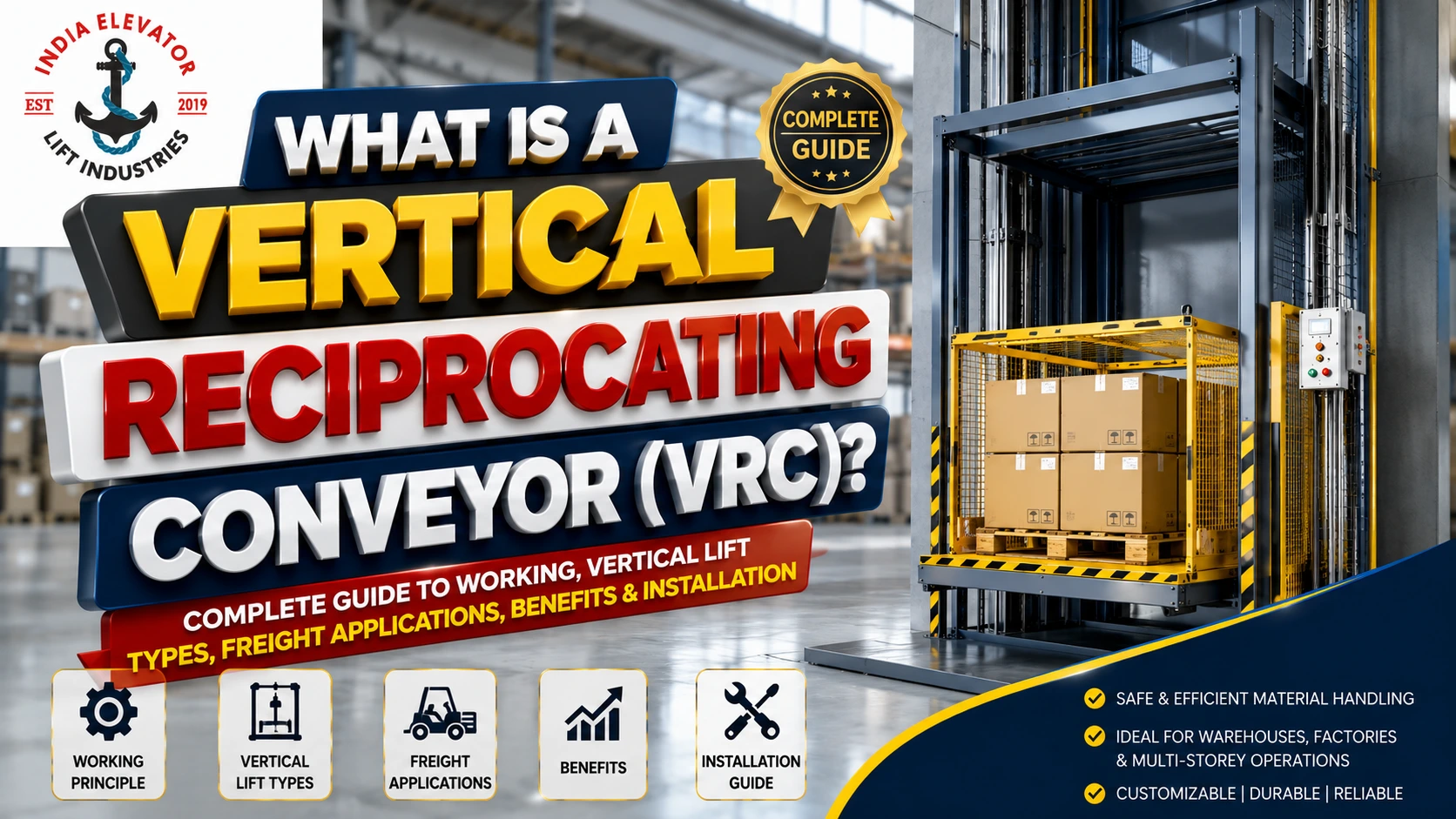
Introduction of Vertical Reciprocating Conveyor (VRC)
All businesses that grow experience a period when manual transportation of materials from one floor level to another brings several problems. Employees have to waste their time carrying heavy loads; it becomes hard to operate forklifts because of space constraints; productivity goes down, and there are issues with inefficient transportation of goods. Many people assume that those are problems that should be solved by increasing the workforce or buying new equipment. However, in many cases, such problems arise due to the lack of a vertical material handling system.
This is where a Vertical Reciprocating Conveyor comes into play as one of the best solutions that an industry may find. Instead of asking employees to carry heavy materials manually and using hazardous techniques for lifting them, a Vertical Reciprocating Conveyor allows moving the load between floor levels quickly, efficiently, and reliably. This solution does not aim to substitute people, but to get rid of extra risks.
Here at India Elevator, we believe that choosing a lifting system must start from analyzing your challenges as opposed to simply buying any machine that is available in the market. Each warehouse, manufacturing plant, logistics hub, retail outlet, pharmaceutical company, automobile workshop, or industrial building has its own needs. Your lifting equipment must offer solutions for some of the common challenges such as lowering loading times, improving worker safety, utilizing available space, and continuous flow of materials.
In order to make the whole process easier for you, we have put together this comprehensive guide. We hope that by going through it, you will be able to know all there is to know about the vertical reciprocating conveyor before making any investment.
Understanding a Vertical Reciprocating Conveyor
A vertical reciprocating conveyor is a sturdy system meant for moving goods safely up and down in two or more floor levels. This kind of transport equipment is solely designed for carrying materials, equipment, pallets, cartons, machinery, and industrial products since it is not meant for passengers. The sturdy design and lifting mechanisms used make this kind of machine the perfect choice for industrial use.
Most companies in various industries have named this transport equipment a reciprocating vertical conveyor, vertical reciprocating lift, or industrial vertical lift since this machine keeps on moving the load up and down vertically. No matter the name, the intention of the machine is always the same, which is providing safe and reliable vertical transport of materials.
There has been a growing need for vertical reciprocating conveyors because most companies now look forward to automating their work processes, increasing safety standards, and using space effectively. Instead of expanding their horizontal space, most companies now expand their vertical space.
What Is a Vertical Lift?
Vertical lift is a machine built to move loads in vertical directions to other floors of a structure. In contrast to conveyors, which move loads horizontally, vertical lifts move loads only vertically.
In an industrial setting, lift vertical system plays a vital role in improving manufacturing processes since it connects various floors without the need for ramping or manual handling. The choice of vertical hydraulic lift or electric lift depends on the use case.
Verticle lift is a wrong spelling in most cases. The engineering name is vertical lift. Whatever your reason for choosing to either build or upgrade your industrial manufacturing process, the right vertical lifting system will help you immensely.
Why Modern Industries Need Vertical Material Handling Solutions
As businesses grow, their material handling requirements become more complex. Production increases, inventory expands, and transportation between floors becomes more frequent. Without an efficient lifting system, businesses often experience:
- Delayed production cycles
- Increased labor costs
- Higher risk of workplace injuries
- Product damage during manual transportation
- Congested work areas
- Reduced operational efficiency
- Poor utilization of vertical building space
- Slower warehouse operations
A properly designed vertical reciprocating conveyor eliminates these challenges by creating a dedicated pathway for moving goods safely and efficiently.
How Does a Vertical Reciprocating Conveyor Work?
The working principle of a Vertical Reciprocating Conveyor is straightforward but highly effective. Every component is designed to ensure stable, reliable, and controlled vertical movement of heavy loads.
Loading the Platform
The process begins by placing goods, pallets, equipment, or materials onto the lift platform. The platform is engineered to distribute weight evenly for safe lifting.
Activating the System
The operator uses a control panel to initiate the lifting cycle. Depending on the design, the system may operate through push-button controls, automatic controls, or integrated warehouse management systems.
Lifting Mechanism
The platform moves vertically along heavy-duty guide rails. In many industrial applications, a hydraulic vertical lift system generates the lifting force using hydraulic pressure. Other systems may utilize mechanical or chain-driven mechanisms depending on project requirements.
Stable Vertical Movement
Guide rails maintain platform alignment throughout the lifting process, preventing unnecessary vibration or movement while transporting heavy loads.
Safe Material Transfer
Once the desired floor level is reached, safety mechanisms lock the platform into position, allowing operators to load or unload materials safely.
The complete lifting cycle is smooth, controlled, and designed to maximize safety while minimizing downtime.
Main Components of a Vertical Reciprocating Conveyor
The overall performance of a vertical reciprocating conveyor depends on the quality of its engineering and components.
Heavy-Duty Platform
The platform carries goods securely and is manufactured using high-strength steel to withstand demanding industrial conditions.
Guide Rail Assembly
Precision guide rails ensure straight vertical movement while maintaining platform stability.
Drive Mechanism
Depending on the project requirements, the system may incorporate hydraulic, chain-driven, or cable-operated lifting technology.
Hydraulic Power Unit
Where a vertical hydraulic lift is used, the hydraulic power unit supplies the pressure required to raise and lower the platform smoothly.
Control Panel
Modern systems feature user-friendly control panels equipped with safety indicators, emergency stop functions, and operational controls.
Safety Gates
Interlocked safety gates prevent unauthorized access during operation and ensure operator protection.
Electrical System
Industrial-grade electrical components coordinate lift movement, safety monitoring, and control functions.
Safety Locking Devices
Mechanical safety devices secure the platform during maintenance or emergency conditions.
Technical Specification Table
| Specification | Details |
|---|---|
| Product Type | Vertical Reciprocating Conveyor (VRC) |
| Lifting Capacity | 500 kg – 10,000 kg |
| Travel Height | Up to 30 meters |
| Platform Size | Customized |
| Drive System | Hydraulic / Chain Driven |
| Lift Type | Vertical Material Lift |
| Structure | Heavy-Duty Steel |
| Operating Speed | 0.10–0.30 m/s |
| Number of Stops | 2–6 Floors |
| Control System | Push Button / Automatic |
| Safety Features | Safety Gates, Emergency Stop, Overload Protection |
| Power Supply | Three Phase |
| Installation Type | Indoor / Outdoor |
| Platform Finish | Anti-Slip Steel Plate |
| Applications | Industrial, Warehouse & Commercial |
Types of Vertical Lifts
Different industries require different lifting solutions. Selecting the correct configuration depends on building layout, available space, load capacity, and operational frequency.
Hydraulic Vertical Lift
A hydraulic vertical lift uses hydraulic cylinders to generate lifting force. It is widely preferred for heavy-duty industrial applications because of its smooth operation and high load-handling capability.
Chain-Driven Vertical Reciprocating Conveyor
Ideal for continuous industrial applications where reliable mechanical lifting is required.
Enclosed Vertical Reciprocating Lift
Designed for facilities where materials require additional protection during transportation.
Heavy-Duty Industrial Vertical Lift
Suitable for factories, engineering plants, automobile manufacturing units, logistics hubs, and distribution centers handling large and heavy materials.
Warehouse Vertical Lift
Specifically developed for inventory movement between storage floors while maximizing warehouse efficiency.
Applications Across Different Industries
A vertical reciprocating conveyor has become an essential material handling solution across numerous industries.
Some of the most common applications include:
Manufacturing Industries
Transporting raw materials, machine components, finished products, and production equipment.
Warehouses
Moving pallets, cartons, inventory, and storage materials between different floor levels.
Automobile Industry
Handling engines, vehicle components, spare parts, and heavy assemblies safely.
Pharmaceutical Industry
Moving medicines, packaging materials, laboratory equipment, and production supplies.
Food Processing Plants
Transporting ingredients, packaged products, and processing equipment efficiently.
Logistics & Distribution Centers
Supporting high-volume movement of goods while reducing loading and unloading time.
Retail & Commercial Buildings
Connecting storage areas with retail floors for efficient stock replenishment.
A properly planned VRC installation allows businesses to improve productivity without expanding their existing floor space, making it one of the most practical long-term investments for industrial facilities.