
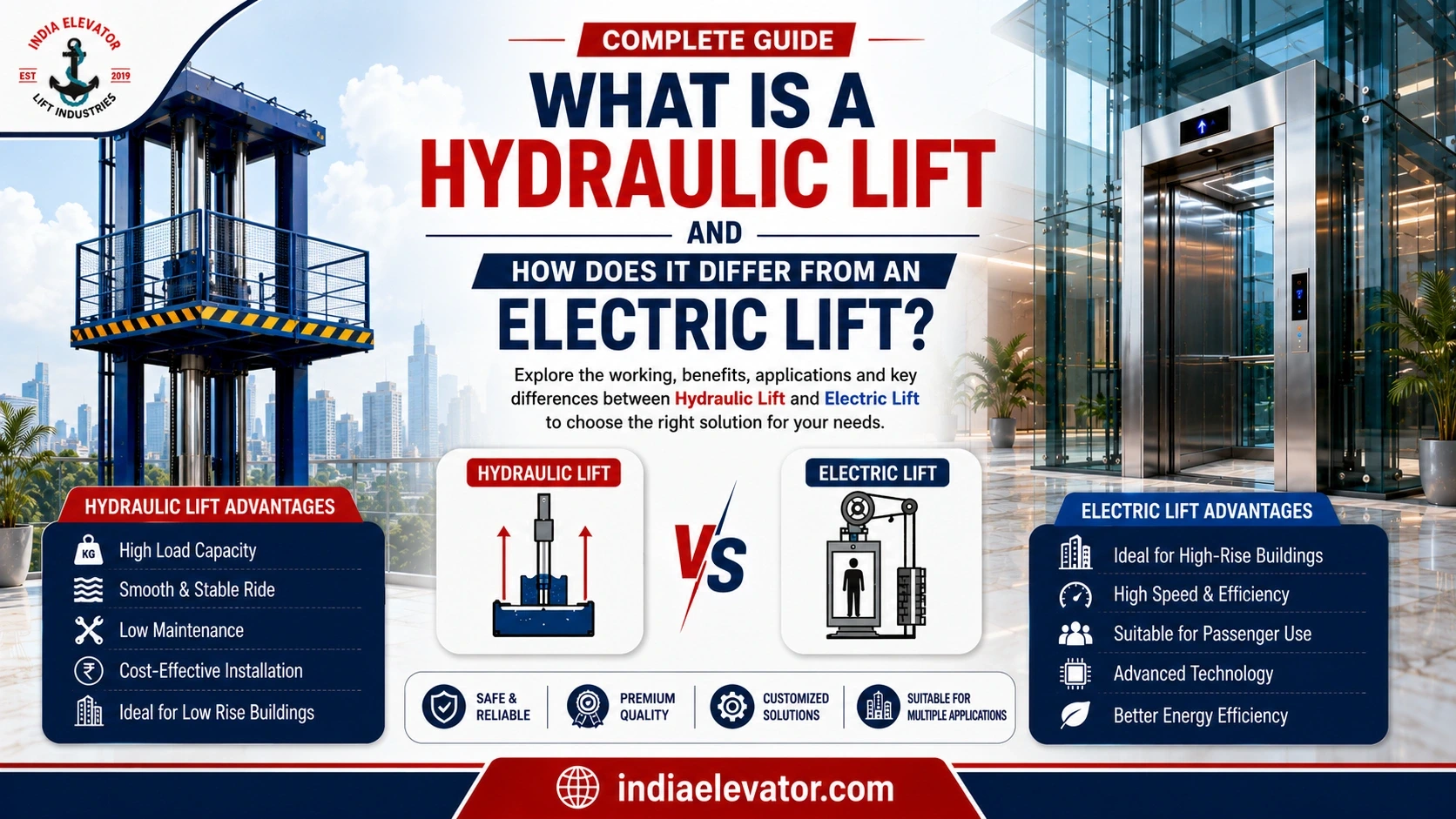
With the changing face of industries, commerce, and residences, lifts have become an integral part of the current infrastructural setup. It may be a tall building, storage facility, shopping center, hospital, or factory – lifts provide a means for safe and convenient vertical transport. While there are different types of lifts in the market currently, the hydraulic lift and electric lift are two of the most commonly used lifts. But many people still ask what is hydraulic lift and what is the difference is between it and the electric lift.
At India Elevator, we feel that having knowledge about the different lift systems helps our customers make informed decisions. Through this comprehensive guide, we will tell you all about hydraulic lift, its functioning, advantages, application, and differences from electric lifts.
What is a Hydraulic Lift?
A hydraulic lift, it is a lifting system that uses hydraulic fluid pressure to move a platform or elevator cabin vertically. The system operates based on Pascal’s Law, which states that pressure applied to a confined fluid is transmitted equally in all directions.
A hydraulic lift consists of several important components, including:
- Hydraulic cylinder
- Piston or ram
- Hydraulic pump
- Oil reservoir
- Control valves
- Lift cabin or platform
When hydraulic fluid is pumped into the cylinder, pressure is created that pushes the piston upward, raising the lift. When the fluid is released back into the reservoir, the lift descends smoothly.
In simple terms, a lift hydraulic system converts fluid pressure into lifting force, enabling heavy loads and passengers to move safely between floors.
About Hydraulic Lift Technology
Knowledge about hydraulic lift systems goes a long way in explaining their continued popularity in different industries.
While traction lifts make use of ropes and pulleys in lifting people and objects, hydraulic lifts depend on fluid power for their operations. Hydraulic lifts are especially effective in low and medium-rise buildings.
Hydraulic lifts are widely appreciated for:
- Smooth lifting performance
- High load-bearing capacity
- Simple mechanical structure
- Lower installation requirements
- Reliable operation in industrial environments
These features make hydraulic lifts ideal for both passenger and freight transportation.
How Does a Hydraulic Lift Work?
The working principle of a hydraulic lift is relatively straightforward:
Step 1: Activation
When the lift is called, the electric motor powers the hydraulic pump.
Step 2: Fluid Pressurization
The pump forces hydraulic oil from the reservoir into the cylinder.
Step 3: Upward Movement
The pressurized oil pushes the piston upward, which raises the lift platform or cabin.
Step 4: Controlled Stopping
Once the lift reaches the desired floor, control valves regulate and stop the flow of hydraulic fluid.
Step 5: Downward Travel
To lower the lift, valves gradually release the hydraulic oil back into the reservoir, allowing the cabin to descend safely.
This efficient process enables hydraulic lifts to transport passengers and materials with excellent stability and control.
What is an Electric Lift?
The electric lift, also referred to as the traction elevator, works on the principle of an electric motor, steel cables, pulleys, and counterweights.
Unlike hydraulic lifts, which rely on hydraulic power, electric lifts employ mechanical traction, which is powered by the electric motor. With the rotation of the motor, the cables move the elevator cabin up or down, depending on the weight balance provided by the counterweights.
Electric lifts are mostly used in high-rise structures because of their height capacity.
Hydraulic Lift vs Electric Lift: Key Differences
1. Working Mechanism
Hydraulic Lift
- Uses hydraulic fluid pressure
- Operates through a piston and cylinder system
Electric Lift
- Uses an electric motor and traction system
- Operates with ropes and counterweights
2. Installation Requirements
Hydraulic Lift
- Requires less overhead space
- Easier to install in existing buildings
Electric Lift
- Requires additional machinery and shaft space
- More complex installation process
3. Load Capacity
Hydraulic Lift
- Excellent for carrying heavy loads
- Commonly used in industrial applications
Electric Lift
- Suitable for passenger transportation and high-rise buildings
4. Travel Height
Hydraulic Lift
- Best for low-rise and medium-rise structures
- Typically used for fewer floors
Electric Lift
- Ideal for high-rise buildings
- Can travel much greater heights
5. Maintenance
Hydraulic Lift
- Fewer moving parts
- Easier servicing and maintenance
Electric Lift
- Requires periodic inspection of ropes, motors, and traction systems
6. Ride Comfort
Hydraulic Lift
- Smooth and quiet operation
- Excellent stability while carrying loads
Electric Lift
- Faster travel speeds
- Efficient for buildings with high traffic
Advantages of Hydraulic Lifts
Hydraulic lifts continue to be a popular choice because of their numerous benefits.
High Lifting Power
Hydraulic systems generate substantial lifting force, making them suitable for transporting heavy equipment and goods.
Cost-Effective Installation
The installation cost of hydraulic lift is generally lower compared to many traction-based systems.
Enhanced Safety
Hydraulic lift are designed with multiple safety features that help ensure controlled movement and secure operation.
Smooth Performance
The fluid-powered mechanism provides steady acceleration and deceleration, minimizing jerks during travel.
Space Efficiency
Hydraulic lift often require less structural modification, making them ideal for retrofitting projects.
Applications of Hydraulic Lifts
Hydraulic lift are used across a wide range of industries and facilities, including:
- Residential buildings
- Commercial complexes
- Hospitals
- Hotels
- Warehouses
- Manufacturing plants
- Automobile service centers
- Shopping malls
- Industrial facilities
- Material handling units
Their versatility makes them one of the most dependable lifting solutions available today.
When Should You Choose a Hydraulic Lift?
A hydraulic lift is an excellent option when:
- The building has fewer floors.
- Heavy load transportation is required.
- Installation space is limited.
- Smooth and reliable operation is a priority.
- Cost-effective lifting solutions are needed.
For industrial and commercial applications, hydraulic lift often provide better value due to their strength and durability.
Why Choose India Elevator for Hydraulic Lift Solutions?
Our main aim at India Elevator is to provide hydraulic lifts that are not only safe and efficient but also reliable in the long run. These lifts have been made by combining the best technologies and materials in order to offer excellent performance in all sorts of conditions.
We can design and manufacture a variety of lifts according to your individual needs, including passenger lifts, goods lifts, freight elevators, car lifts, and others.
Conclusion
Knowing about what is hydraulic lift technology is would be beneficial for companies and individuals to choose an appropriate type of lift according to their requirements. Hydraulic lifts use fluid pressure to carry both people and goods efficiently and safely, whereas the electric lifts work through the process of traction using motors and counterweights.
There are certain pros and cons of each type of lift, but it is still widely acknowledged that the hydraulic lift is the better option for low-rises, heavy-duty jobs, and other projects that require good lifting performance. Knowing the difference between the lift hydraulic system and an electric lift will help you choose the best lift for your needs.
India Elevator is a company that produces high-quality hydraulic lift with professional engineering support.