
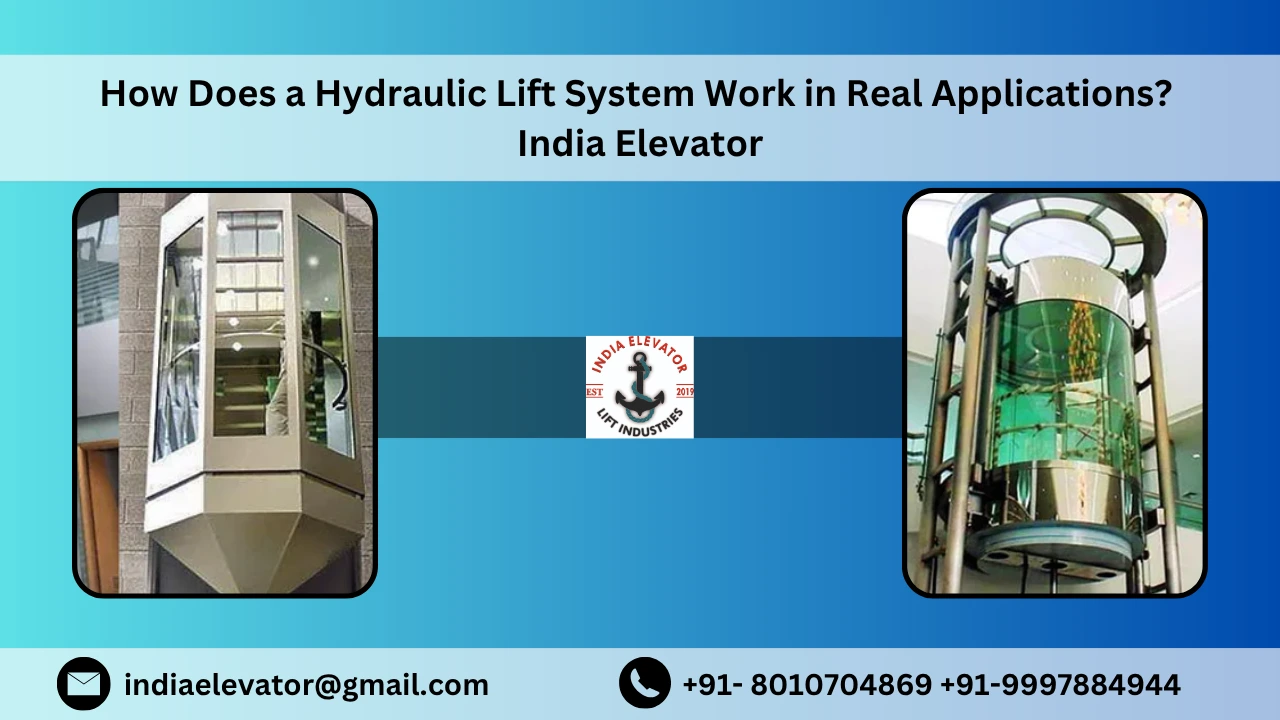
The elevator system allows you to move between different floors who enter an elevator because it uses advanced engineering technology to achieve its operation. The hydraulic lifts system operates with its basic design, which provides dependable service and effective performance for buildings that reach up to six stories in height. The India Elevator blog post will explain the concept using simple language, which helps readers understand how hydraulic lift systems function in actual situations.
What is Hydraulic Lift?
Before we begin studying mechanics, we need to answer an essential question about hydraulic lifts.
A hydraulic lifts operates as an elevator system which uses hydraulic fluid pressure to move its cabin vertically. The system operates through a piston mechanism which uses pressurized oil to raise and lower the elevator car instead of using the cable and counterweight system found in traction elevators.
Hydraulic Lift Definition
In simple terms, the hydraulic-lifts definition can be described as:
- A lifting mechanism that operates using a liquid (usually oil) under pressure to generate force and move a platform or cabin vertically.
This system is widely used in residential buildings, hospitals, warehouses, and industrial settings due to its smooth operation and cost-effectiveness.
Working of Hydraulic Lift
Now let’s understand the working of hydraulic lifts in a practical, easy-to-follow way.
At the core of the system are three main components:
- A cylinder
- A piston (plunger)
- A hydraulic fluid (oil)
Step-by-Step Process
- Motor Activation – When you press the elevator button, an electric motor starts pumping hydraulic fluid from a reservoir into a cylinder.
- Fluid Pressure Builds Up – As the fluid enters the cylinder, it creates pressure.
- Piston Movement – This pressure pushes the piston upward, and since the elevator car is mounted on the piston, it rises along with it.
- Controlled Descent – To go down, the system simply releases the fluid back into the reservoir in a controlled manner, allowing the car to descend smoothly using gravity.
Hydraulic Lift Project Explanation
If you’ve ever seen a hydraulic lift project explanation in school or engineering demonstrations, it usually involves a simple setup using syringes and tubes.
Here’s the idea behind it:
- Two syringes are connected with a tube filled with liquid.
- When you press one syringe, the liquid transfers force to the other.
- This demonstrates Pascal’s Law, which states that pressure applied to a confined fluid is transmitted equally in all directions.
This same principle is scaled up in real hydraulic-lifts, where powerful pumps and cylinders replace the syringes.
Real-Life Applications of Hydraulic Lifts
Hydraulic-lifts are not just theoretical—they are widely used in everyday life. Here are some practical applications:
- Residential Buildings – Perfect for low-rise apartments and homes because they require less space and are easier to install.
- Hospitals – Provide smooth and jerk-free movement, which is essential for transporting patients and medical equipment.
- Car Showrooms and Parking Systems – Used to lift vehicles efficiently between levels.
- Warehouses and Factories – Handle heavy loads with ease, making them ideal for industrial use.
Advantages of Hydraulic Lift Systems
Why do so many industries prefer hydraulic-lifts? Here are a few reasons:
- Smooth Operation: Minimal jerks or vibrations
- Cost-Effective: Lower installation and maintenance costs
- Space-Saving: No need for overhead machinery rooms in some designs
- High Load Capacity: Ideal for carrying heavy weights
Limitations to Consider
While hydraulic lifts are excellent, they do have some limitations:
- Slower compared to traction lifts
- Not ideal for very tall buildings
- Requires proper maintenance to prevent oil leaks
Final Thoughts
People who study hydraulic lift systems come to understand how engineers create technologies which we use without thinking. The principle of fluid pressure as an uplifting force applies to both basic educational models and actual operational systems.
At India Elevator, our belief asserts that people who understand their options make better infrastructure choices. Our systems provide essential knowledge about contemporary vertical transportation systems, which building designers and curious individuals need to understand.